
GEO vs SEO: 7 Key Differences in the Age of AI Overviews
Search is no longer just ten blue links. Here is the practical guide to GEO vs SEO, generative engine optimization, AI Overviews and ChatGPT SEO, written for business owners who want to stay visible.
If you have noticed that your Google traffic is shifting while your rankings look stable, you are seeing the effect of AI answers. The debate around GEO vs SEO is now one of the most important conversations in digital marketing, because the way people find information has changed. Customers still type queries into Google, but they also ask ChatGPT, Perplexity, Gemini and Copilot, and they read AI Overviews at the top of the results page before they ever scroll to a website.
This guide explains GEO vs SEO in plain language. You will learn what each discipline means, the 7 key differences that matter, and how to combine both into one strategy that protects your current traffic while earning visibility in AI-generated answers. Whether you run a local shop, a manufacturing company or an online brand, understanding GEO vs SEO will help you make smarter marketing decisions this year.
Quick Answer: GEO vs SEO
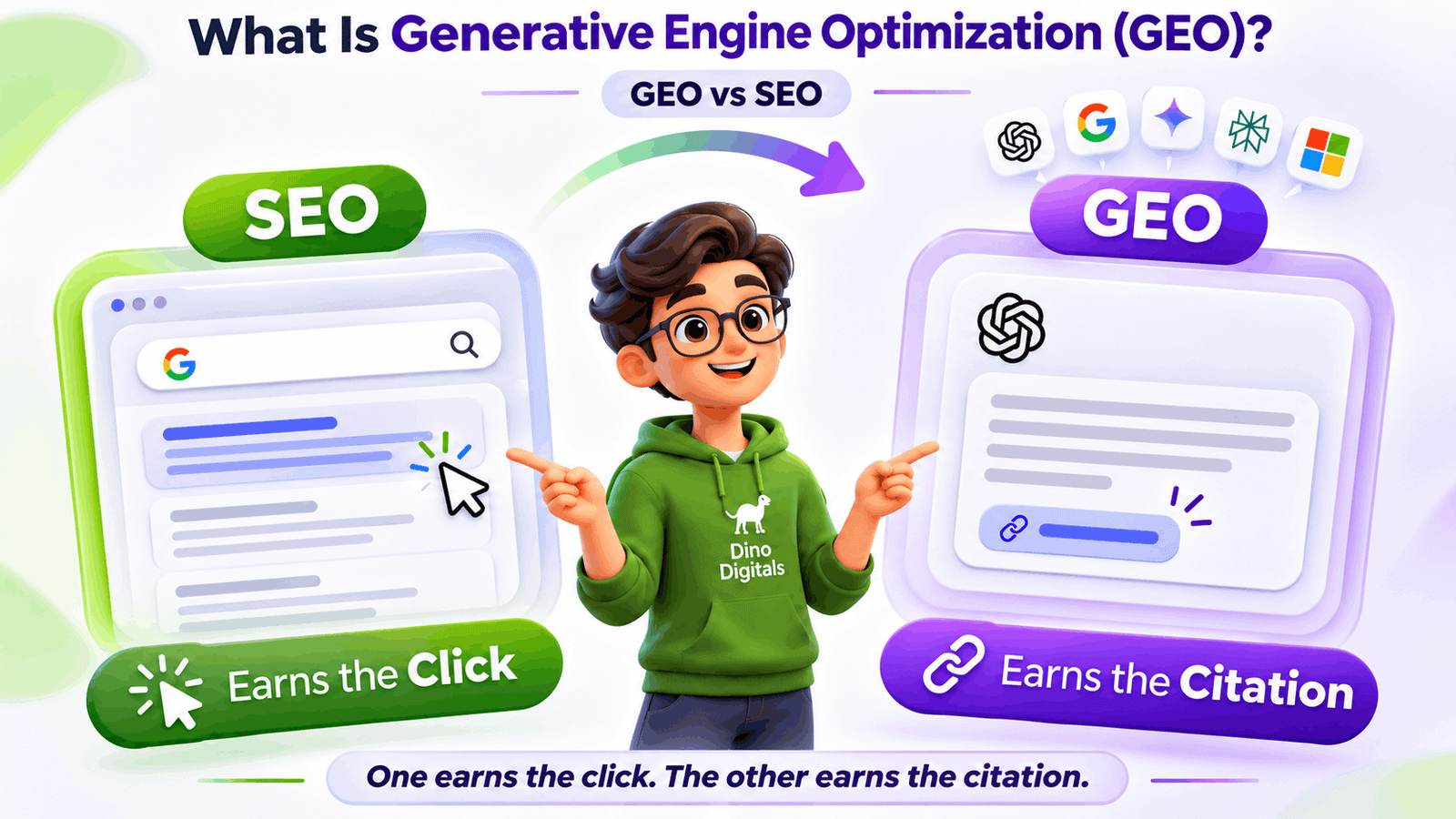
SEO helps your pages rank and earn clicks on search result pages. GEO, or generative engine optimization, helps your brand get cited and recommended inside AI-written answers. In the GEO vs SEO comparison, SEO is the foundation and GEO is the next layer built on top of it.
What Is SEO? A Quick Refresher
Search engine optimization is the process of improving your website so it ranks higher in search engines like Google and Bing. It covers keyword research, on-page content, technical health, page speed, backlinks and local signals such as your Google Business Profile. The goal of traditional SEO is simple: appear on page one, earn the click and convert the visitor.
SEO is not going away. Every serious GEO vs SEO discussion starts with this truth, because AI systems rely on well-structured, crawlable and trusted web pages as their source material. If your site is slow, thin or poorly organized, AI tools are unlikely to cite it either.
What Is Generative Engine Optimization (GEO)?
Generative engine optimization is the practice of shaping your content, brand and online presence so that AI models can find, understand, trust and quote you in their answers. Instead of competing for a position on a results page, you compete to be one of the few sources an AI mentions in a single synthesized response.
That includes Google AI Overviews, ChatGPT search, Perplexity, Gemini and Microsoft Copilot. People often call the practice of showing up in these tools ChatGPT SEO, answer engine optimization or LLM optimization. The names differ, but the idea is identical: make your content the easiest, safest and most useful thing for an AI to cite.
GEO vs SEO: 7 Key Differences
Now let us break down the 7 key differences in the GEO vs SEO comparison, so you can see exactly where your strategy needs to evolve.
Goal: Rankings vs Citations
The first difference in GEO vs SEO is the finish line. SEO aims for a high ranking position and a click to your website. GEO aims for a citation, a mention or a recommendation inside an AI answer, often with no click at all. Success is measured by how often your brand appears in the answer, not only where your link sits on a page.
This changes how you report results. A brand can be named in thousands of AI answers and still see modest click growth, so visibility metrics matter as much as traffic.
Platforms: Google vs Many AI Engines
SEO is largely a Google and Bing game. Generative engine optimization spans AI Overviews, ChatGPT, Perplexity, Gemini and Copilot, and each one retrieves and ranks sources differently. A page that wins on Google may be ignored by ChatGPT, and the reverse is also true.
That is why a modern GEO vs SEO plan tests visibility across several platforms instead of watching a single rank tracker.
Keywords vs Questions and Context
Traditional SEO is built around short keyword phrases. GEO is built around full questions and conversational prompts, such as “which agency is best for local SEO and AI search?” AI users ask longer, more specific questions and expect a direct answer.
In the GEO vs SEO shift, you move from targeting one phrase per page to answering a whole cluster of related questions clearly and completely on the same page.
Content Format: Pages vs Answer Blocks
SEO rewards comprehensive pages with strong headings and internal links. GEO rewards pages that contain short, self-contained answer blocks that an AI can lift and quote. Think of a two or three sentence definition directly under a question heading, followed by supporting detail.
Lists, tables, definitions and clear step-by-step explanations are easy for AI to parse, which is why they perform so well when comparing GEO vs SEO tactics.
Authority: Backlinks vs Brand Mentions
Backlinks remain a core SEO signal. In generative engine optimization, brand mentions across trusted websites, reviews, directories, forums and news sources carry enormous weight, because AI models learn which brands are associated with which topics. Even an unlinked mention can strengthen your entity.
The practical lesson in GEO vs SEO is to build a consistent brand footprint everywhere your customers and AI tools look, not just a pile of links.
Technical Focus: Crawlability vs Machine Readability
SEO technical work covers site speed, mobile usability, indexing and Core Web Vitals. GEO adds machine readability: clean HTML, schema markup, FAQ and organization structured data, clear authorship and fast server responses so AI crawlers can fetch your content without friction.
Both sides of GEO vs SEO need a healthy website, but GEO places extra emphasis on structured data that tells AI exactly who you are and what you do.
Measurement: Traffic vs Share of Voice
SEO is tracked with rankings, impressions, clicks and conversions. GEO needs new metrics: how often your brand is cited in AI Overviews, how frequently ChatGPT recommends you, the sentiment of those mentions and your share of voice against competitors for key prompts.
The most mature GEO vs SEO reports combine both, showing traditional traffic alongside AI visibility so you see the full picture.
GEO vs SEO Comparison Table
| Factor | SEO | GEO |
|---|---|---|
| Main goal | Rank and earn clicks | Get cited in AI answers |
| Where it works | Google, Bing | AI Overviews, ChatGPT, Perplexity, Gemini |
| Query style | Short keywords | Full questions and prompts |
| Key signal | Backlinks | Brand mentions and entity trust |
| Best format | Long, optimized pages | Clear answer blocks, lists, schema |
| Success metric | Rankings and traffic | Citations and share of voice |
How AI Overviews Changed the GEO vs SEO Conversation
Google’s AI Overviews now summarize answers at the top of many searches, pulling facts from several sources and linking to a handful of them. For informational queries, this means fewer people click through, and the sites that are cited gain a trust boost that unlisted competitors do not.
The lesson from AI Overviews is not to panic. Pages that already rank well, answer questions directly and show real expertise are the ones most likely to be cited. This is why GEO vs SEO should never be treated as a choice between two rival tactics. Strong SEO gets you into the pool of candidate sources, and strong GEO makes the AI choose you from that pool.
ChatGPT SEO: How to Get Recommended by AI Assistants
ChatGPT SEO is the part of generative engine optimization focused on showing up when people ask ChatGPT for advice, comparisons and recommendations. Because ChatGPT blends its training knowledge with live web retrieval, your visibility depends on both long-term brand authority and fresh, crawlable content.
To improve your ChatGPT SEO, publish factual and specific content, keep your business details consistent on every platform, earn reviews and third-party mentions, and update key pages regularly. Avoid vague marketing language; AI systems prefer clear statements they can safely repeat.
A Practical GEO vs SEO Strategy You Can Start Today
You do not need to rebuild your marketing from scratch. Follow these steps to cover both sides of GEO vs SEO at once.
1. Fix your SEO foundation first
Make sure your site is fast, mobile friendly, indexed and free of technical errors. Without this base, no amount of generative engine optimization will help.
2. Write answer-first content
Put a direct two or three sentence answer under every question heading, then expand with examples and data. This one habit improves both rankings and AI citations.
3. Add structured data
Use FAQ, Organization, LocalBusiness and Article schema so machines can understand your content without guessing.
4. Build entity authority
Keep your name, address, phone number and service descriptions identical across Google Business Profile, directories and social profiles. Collect genuine reviews and pursue mentions on respected industry sites.
5. Refresh content regularly
AI engines favor current information. Update statistics, dates and examples on your most important pages every few months.
6. Track both worlds
Monitor rankings and traffic for SEO, and manually test your key prompts in AI Overviews, ChatGPT and Perplexity each month to see whether your brand appears.
Why the GEO vs SEO Shift Matters for Your Revenue
AI-driven search is changing buyer behavior faster than most businesses realize. Visitors who arrive after reading an AI answer are often further along in their decision, because the AI has already compared options and summarized the benefits. When your brand is the one recommended, you are effectively endorsed before the visitor lands on your site, and that usually means higher-quality enquiries and better conversion rates.
On the other side, brands that ignore generative engine optimization risk becoming invisible at the exact moment customers ask for advice. A competitor that appears in AI Overviews and ChatGPT answers collects trust, brand recall and leads, while your well-ranked pages may still get fewer clicks than before. That is the real cost of ignoring GEO vs SEO: you lose influence at the top of the buying journey.
Content that works well for both GEO and SEO
Some content types perform strongly in both worlds. Definition pages, how-to guides, original research, comparison articles, pricing explainers and detailed FAQs all give search engines clear topics to rank and give AI systems clean passages to quote. When planning your editorial calendar, prioritize formats that answer real customer questions with specific facts, examples and local expertise.
What the future of GEO vs SEO looks like
Expect AI answers to keep expanding, with more conversational follow-up questions, more shopping and local recommendations, and more personalization. Businesses that build trusted brands, structured websites and genuinely helpful content today will carry that advantage into every new AI platform that appears. The smartest move is to treat GEO vs SEO as one connected discipline and to keep testing, learning and improving every month.
Common Mistakes in the GEO vs SEO Shift
The biggest mistake is abandoning SEO because of AI hype. Since AI answers draw from ranking, trusted pages, dropping SEO weakens your GEO results too. The second mistake is keyword stuffing; AI models understand meaning, so natural, helpful writing beats repetition. The third is ignoring local and brand signals, which are central to generative engine optimization for service businesses.
Finally, many businesses publish thin, generic content that says nothing new. When comparing GEO vs SEO, remember that originality wins in both: first-hand experience, real numbers and clear opinions give AI something worth quoting.
Is GEO vs SEO Right for Local Businesses?
Absolutely. Local customers increasingly ask AI tools for recommendations like “best digital marketing agency near me” or “who can build a website for my clinic?” A business with a complete Google Business Profile, strong reviews and well-structured service pages has a real advantage in both classic local search and AI answers.
If you are a business in Tamil Nadu and want expert help with GEO vs SEO, explore our digital marketing agency in Coimbatore services to see how we combine search, content and AI visibility into one growth plan.
GEO vs SEO: Frequently Asked Questions
What is the difference between GEO and SEO?
SEO earns rankings and clicks on search result pages, while GEO, or generative engine optimization, earns citations and mentions inside AI-written answers from AI Overviews, ChatGPT and Perplexity. The GEO vs SEO difference comes down to clicks versus citations.
Is SEO dead because of AI Overviews?
No. AI Overviews still pull from pages that rank well and are trusted, so SEO remains the foundation. GEO vs SEO is not a replacement story; it is an evolution of the same goal of being found.
What is generative engine optimization?
Generative engine optimization is the practice of structuring content, schema and brand signals so AI systems can understand, trust and cite your business in generated answers.
How do I rank in ChatGPT?
Publish clear, factual and well-structured content, build brand mentions on trusted sites, keep business information consistent and refresh pages often. These habits are the core of ChatGPT SEO.
Do I need both GEO and SEO?
Yes. A combined GEO vs SEO strategy protects your search rankings while making your brand visible wherever people now ask questions, from Google to AI assistants.
How long does GEO take to show results?
Most businesses see early AI citation improvements within two to four months of consistent content, schema and authority work, though competitive topics can take longer.
Which should I invest in first, GEO or SEO?
Start with SEO fundamentals, then layer GEO on top. In the GEO vs SEO order of operations, a healthy, authoritative website makes every GEO tactic work better.
Ready to Win the GEO vs SEO Race?
Let GS Digital Marketing build a search strategy that ranks on Google and gets you cited by AI. Call or message us today for a free consultation.
📱 9514020352