
E-E-A-T in SEO: 7 Trust Signals Google Wants from Your Website
Learn how E-E-A-T in SEO shapes rankings, and which seven trust signals will make your website credible, helpful and impossible for Google to ignore.
Why E-E-A-T in SEO Matters More Than Ever
If your pages are well written but still stuck on page two, the missing piece is often E-E-A-T in SEO. Google uses the framework of Experience, Expertise, Authoritativeness and Trustworthiness to judge whether a page deserves to rank, especially for topics that affect health, money or safety. In 2026, with AI-generated pages flooding the web, E-E-A-T in SEO has become the fastest way for real businesses to stand out.
Here is the important part: E-E-A-T is not a single ranking switch you can turn on. It is a set of quality signals that Google’s systems and human quality raters look for across your entire site. The stronger those signals, the stronger your website credibility, and the easier it becomes to earn the visibility that Google helpful content updates reward.
In this guide you will learn what E-E-A-T in SEO means, the seven trust signals Google wants from your website, how to apply each one, and the mistakes to avoid. If you would rather have specialists handle it, our team at a digital marketing agency in Coimbatore can audit your site and build a trust-first SEO plan.
What Is E-E-A-T in SEO?
E-E-A-T in SEO is Google’s way of describing content quality. It comes from the Search Quality Rater Guidelines, which thousands of reviewers use to test whether search results are reliable. Each letter stands for a quality that both people and algorithms can recognise.
Experience
Proof that the creator has personally used, tried or lived the topic.
Expertise
Real knowledge, skill and qualifications in the subject area.
Authoritativeness
Recognition from others as a go-to source in your industry.
Trustworthiness
Accuracy, honesty, transparency and safety, the most important of all four.
Trust sits at the center. A page can show experience and expertise, but if the site feels unsafe or deceptive, it will struggle. Understanding E-E-A-T in SEO therefore means building a website where every page, author and policy supports one message: this business is real and reliable.
Signal 1A Credible Author Bio and Real Expertise
Google wants to know who is behind your content. A detailed author bio and trust signals such as qualifications, years of experience, a clear photo, social profiles and published work tell readers and algorithms that a real expert wrote the page. Anonymous articles signed by “Admin” are one of the quickest ways to weaken E-E-A-T in SEO.
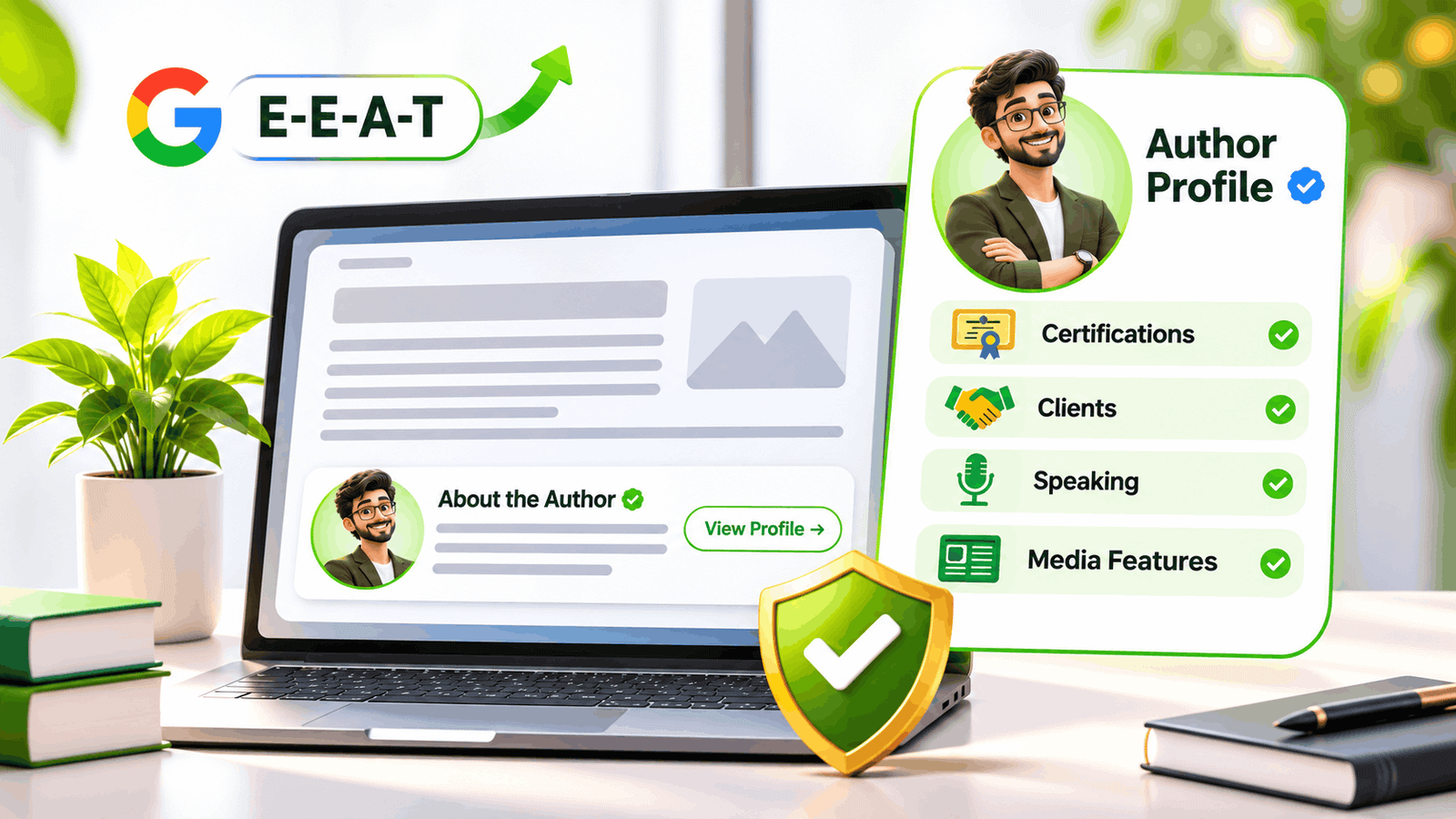
Create a dedicated author page for every writer, link to it from each article, and add Person schema markup. Include specific proof: certifications, shareable client names, speaking engagements and media features. A strong author bio and trust signals setup also helps on sensitive topics, because Google can verify the writer’s background across the web. Keep it honest, since exaggerated claims damage website credibility faster than having no bio at all.
Quick win: add a 60 to 90 word author box with a photo, credentials and a link to the full author page on every post.
Signal 2First-Hand Experience in Your Content
The first “E” was added to reward content created by people who have actually used the product, visited the place or solved the problem. Original photos, screenshots, test results and lessons learned are impossible for generic AI summaries to fake. This is where E-E-A-T in SEO and Google helpful content meet: helpful pages show real-life knowledge, not rewritten search results.
Use language that shows lived experience, such as “we tested this”, “in our client campaign” or “here is what went wrong”. Publish before-and-after data, use your own images instead of stock photos, and explain each process step by step. Readers stay longer, share more and trust you faster, which supports every other part of E-E-A-T in SEO.
Signal 3Transparent About, Contact and Business Details
Visitors and quality raters ask simple questions: who runs this website, where is the business located and how can I reach a real person? A clear About page, a full contact page with phone number, email and address, and visible policy pages are basic website credibility requirements.
Add your company story, team photos, registration or GST details where relevant, and a Google Business Profile that matches your website exactly. Consistent name, address and phone details across directories reinforce E-E-A-T in SEO because they prove your business exists and can be held accountable. Privacy, terms, refund and editorial policies show that you operate responsibly.
Signal 4Authoritative Backlinks and Brand Mentions
Authority is earned when other trusted sites recommend you. Quality backlinks from industry publications, universities, associations and local news sites act as votes of confidence, while unlinked brand mentions and positive discussions help Google recognise your brand. Ten relevant editorial links are worth more than a thousand spammy directory links.
Build authority by publishing original research, expert quotes, free tools and guides that others want to cite. Join industry events, contribute guest articles with a strong author bio and trust signals profile, and use digital PR to earn coverage. Over time these signals raise your website credibility and make E-E-A-T in SEO a competitive advantage instead of a checkbox.
Signal 5Technical Trust: HTTPS, Security and Page Experience
Trustworthiness has a technical side. HTTPS encryption, a fast mobile-friendly layout, no intrusive pop-ups, no broken pages and clear ad labelling all tell users your site is safe. Google calls trust the most important part of E-E-A-T in SEO, so a hacked, slow or confusing site can cancel out great content.
Run regular security scans, update plugins, fix Core Web Vitals issues and protect every enquiry or checkout form. Display payment or security badges only if they are genuine. Every technical improvement lifts website credibility and removes the friction that stops visitors from becoming customers.
Signal 6Reviews, Testimonials and Case Studies
Social proof is one of the strongest trust signals because it comes from other people, not from you. Genuine Google reviews, video testimonials, detailed case studies and client logos show that real customers got real results. For local businesses, review volume, recency and your replies to feedback all matter.
Ask happy customers for reviews after every project, respond politely to negative feedback, and publish case studies with numbers such as traffic growth, leads and revenue impact. Never buy or fake reviews; Google can detect patterns, and the penalty can destroy your E-E-A-T in SEO efforts. Add Review and LocalBusiness schema so search engines can understand your proof.
Signal 7Accurate, Fresh and Helpful Content with Sources
Everything above supports the content itself. Google helpful content systems reward pages written for people first: they answer the question completely, are accurate, easy to read and clearly updated. Cite reputable sources, link to official studies, show published and last updated dates, and correct mistakes openly.
Avoid thin pages, keyword stuffing and mass-produced AI text with no human review. Plan each article around real search intent, add original insight, and refresh high-value pages every few months. Content that satisfies readers builds the long-term website credibility that sustains E-E-A-T in SEO across your whole domain, and it is exactly the kind of Google helpful content the system is designed to promote.
Want Your Website to Pass the E-E-A-T Test?
Our SEO specialists will review your trust signals and give you a clear action plan. Talk to us today.
E-E-A-T in SEO Checklist
- Every article has a named author with a linked author page, photo and credentials.
- Your About, Contact, Privacy and Terms pages are complete and easy to find.
- Content includes original images, data and first-hand examples.
- Claims are backed by reputable sources and show a last updated date.
- Your site uses HTTPS, loads fast and works well on mobile.
- Genuine reviews and case studies appear on key service pages.
- Schema markup is added for Organization, Person, Review and FAQ.
- You earn editorial backlinks and brand mentions every month.
Common E-E-A-T in SEO Mistakes to Avoid
- Publishing without an author: unsigned content gives Google nothing to verify.
- Copying competitors: rewritten content adds no experience and fails the Google helpful content test.
- Hiding contact details: a missing address or phone number hurts website credibility instantly.
- Fake reviews or inflated credentials: short-term gains lead to long-term trust damage.
- Never updating pages: outdated facts signal neglect, especially on fast-changing topics.
Fixing these mistakes is usually the quickest route to progress with E-E-A-T in SEO, because most competitors are making them too.
A 30-Day Plan to Improve E-E-A-T in SEO
Week 1: audit author pages, About and Contact pages, and policies. Week 2: upgrade your top ten pages with first-hand examples, sources and updated dates. Week 3: collect reviews, publish two case studies and add schema markup. Week 4: start link building and digital PR to strengthen authority. Track rankings, organic clicks and branded searches monthly to see how E-E-A-T in SEO improvements translate into growth.
E-E-A-T in SEO: Frequently Asked Questions
What does E-E-A-T stand for in SEO?
E-E-A-T stands for Experience, Expertise, Authoritativeness and Trustworthiness. It is the quality framework Google’s raters use to evaluate whether content and websites are reliable, helpful and created by people who truly understand the topic.
Is E-E-A-T a Google ranking factor?
E-E-A-T is not a direct ranking factor with a score. Google’s systems use many signals that align with E-E-A-T in SEO, such as quality links, accurate content and site reputation, to surface reliable pages.
How do I improve E-E-A-T on my website?
Add detailed author bios, show first-hand experience, publish transparent contact and policy pages, earn quality backlinks, collect genuine reviews, secure your site with HTTPS and keep content accurate and updated.
What is the difference between E-A-T and E-E-A-T?
E-A-T had three parts: Expertise, Authoritativeness and Trustworthiness. Google added the extra “Experience” in December 2022 to value content from people with real, first-hand involvement in the subject.
Does E-E-A-T apply to every website or only YMYL topics?
It matters most for Your Money or Your Life topics like health, finance and legal advice, but it benefits every site. Strong E-E-A-T in SEO improves user confidence and website credibility in any niche.
How long does it take to see results from E-E-A-T improvements?
Most websites notice gradual gains within three to six months as Google recrawls and re-evaluates trust signals. Competitive niches may take longer, so consistency is the key.
Build Trust. Earn Rankings. Grow Faster.
Strong E-E-A-T in SEO is the foundation of lasting visibility. Partner with a trusted digital marketing agency in Coimbatore and let experts strengthen your author bio and trust signals, website credibility and Google helpful content strategy.